What do you do with a child like JV. (It sings nicely if you use his first name.) He resisted every advance to memorize multiplication facts. He was the proud owner of a mini-Pythagorus board that he would whip out in a moment’s notice of math needs. I broke all rules and made him do worksheet after worksheet this past fall. The ability to estimate/approximate numbers left his desire to do square rooting on the shelf.
But now we have reviewed and learned multiplication tables and worked through skills needed again. Here we are standing at the brink of understanding squaring of polynomials.
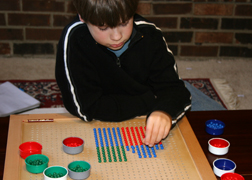
For this work, a peg board and pegs are needed. For all you not Montessori math folk, the colors are representative of place value – green: units, blue: tens, red: hundreds. One of the main reasons for this lesson is to help the child discover that the squares in polynomials “skip” a place in their squaring layout. For example: the square of 235’s layout would find the unit as a green unit in the simple family but the second square is red saying hundreds in the simple family while the third square is leaping over the green units of the thousands family to the blue of the tens in the thousands family.
This work requires multiple multiplication of multiplier to multiplicand in a broken out form: (200 + 30 + 5) x (200 + 30 + 5)= y.
So JV had to multiply – the horror.
200 x 200 = 40,000 (blue tens of thousands square)
200 x 30 = 6, 000
200 x 5 = 1,000
30 x 200 = 6,000
30 x 30 = 900 (red middle square in the layout signifying hundreds place)
30 x 5 = 150
5 x 200 = 1,000
5 x 30 = 150
5 x 5 = 25 (green for units)
The child sees how the other pieces fit into their hierarchal support positions.
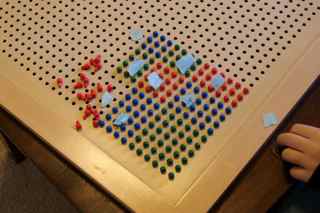
Now, suppose the child makes a mistake in his original calculation and comes up with 5 x 5 = 16 and tries to place 16 beads in the board, he won’t have a square and will see that the answer can’t work.
The usefulness of the visualization helps the child realize the pattern that numbers make in the higher orders of math and almost instinctively know when an error is about to be made and check themselves. I would predict that tomorrow JV will anticipate it.
Then the adding begins. All the original answers are added together to see what the square reads.
Did I mention this is tedious?
So, lets review. The child is working on:
- multiplication facts
- multiplying by 10’s
- place value
- geometry – study of area and study of square
- addition
- actual squaring of a three or four (or more) digit number
PS: For all you Montessorians out there, I too cringe at the way the board is laid out in the first picture. He used the division’s cups to hold the pegs because BR was also doing peg board squaring and initially was using the other side of the board. He let BR use the box. (It took BR a while not to trade in all his previous level’s pegs when he moved to the next hierarchy -so lots of counting.) To facilitate their dual use of the board, they laid the value out at the bottom of the board and then moved up a few rows to lay out the work.
 The Inclusive Atrium