One of the anticipated lessons in the Montessori Elementary is the presentation of the decanomial. It is a giant square (literally and figuratively) and is laid out in beads bars. This is most often accomplished by third year students with legions of adoring first years lending hands with the beads.
The presentations for this work fall into three categories: numeric, geometric, and algebraic. Binomials and trinomials are familiar to the child that is third year (nine). As far as the attraction in the mind of the child, doing the decanomial is similar to doing giant multiplication or division lessons.
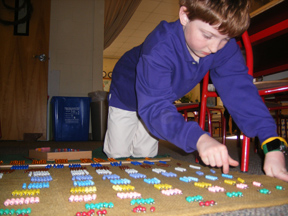
This layout can take days of precision. It requires using a ruler to keep the lines straight. It is important to point out that, as we go, the diagonal is comprised of the squares of 1 through 10. We discuss this and decide that we could replace these squares with the actual squares from the bead cabinet.
Our next visit with the work will have us discuss the commutative law. We look at the two red beads and the one green bead bar. Could we make the work safer and more stable if we replaced the two red beads with one green bar? It says the same thing. OK. Can we do that with others? The great exchange begins – 4 x 3 is the same as 3 x 4, 9 x 10 is equivalent to 10 x 9.
The child needs to spend some time thinking and observing this now. He will be encouraged to write observations (at least five) in his notebook.
The next visit we discuss the look of the work and his observations.
“We have the square of one.
“Look at something I notice. The two green bars (2 x1 and 1 x 2) would make a second square of 2.
“Are there any other ways to replace the bars and make more squares?” All the bars are regrouped to make squares of the varying colors.
At the next visit, we look at the squares and wonder how many of each there are. We also realize that the two squares of two make the cube of two. Wonder about three and so on. Upon completing the squares to cubes, the cubes are stacked into a step tower. When we are done, a procession of children heads down to the 3 to 6 room to fetch the pink tower and compare the tower of numerical squares to the beloved early lesson of the pink tower.
These observations must be written in the child’s note book.
We will work later with the cubes moving backwards to the squares and discuss a formula and rule. “The square of a decanomial in which the ten terms equal the first ten natural numbers equals the sum of the cubes of these numbers.”
I will challenge the rule and see if there is a way for the child to make a universal statement. We will do some problems.
Now, we arrive at the point of discussion for BR – the Geometric Decanomial.

At our next visit I bring out envelopes labeled 0 to 9. Inside the envelopes are paper representations of the bead bars. Beginning with the 0 envelope, we layout the squares in a diagonal. The rectangles from the envelopes 1 -9 are then placed in their spots. We discuss that there are 10 squares and 90 rectangles. We discuss that the rectangles above the squares are congruent to the rectangles below the squares.
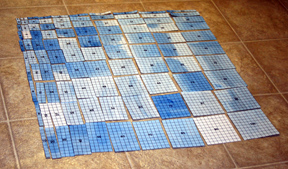
Then he is ready to discuss it Algebraically.
 The Inclusive Atrium