
When you really care about some one, you plan and think and trash the first idea and fuss over the next three ideas until you have the perfect plan. Then you fuss over the card, the presentation, the timing. Montessori is all about that – the prepared environment. The work. The observation to know what someone really needs when. The execution of the plan in the lesson.
Montessori Camps should be the same way. The set-up, although is less rigorous than the out of the box curriculum. The planning is more challenging. How to communicate the concepts? How to provide challenging work to the children? How to provide self-correction? How to ride with it when the kids take for the rabbit trail?
The advantage is that because you are writing your own curriculum you know the kids and their abilities and their likes. You know how to pitch it. You can write segments to play to your volunteer’s strengths. (In the younger kids camp this year, we had a violinist. She was wonderful. We took her skills into account.)
Some random thoughts and illustrations about a Montessori Camp.
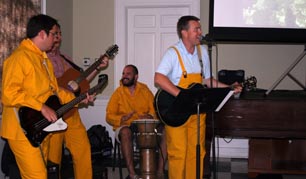
1. If you are going to have music, set the stage up well. Work for success here. Sometimes I’ve worked with just one person and their instrument. It is all in providing a modicum of professionalism.
This year we had an interning seminarian who is a very good guitar player. He sucked in two other guys. They have done this before with curricula I’ve written. They came up with a band name – Joe-Nathan and the Whalers and a back story and personas.
They went down to Wal-Mart and acquired three Gordon Fisherman rain outfits ($7.95 each) and declared that they had tried out for ESPN 12’s reality series. They called their show The Safest Catch and never used hooks (dangerous). Each night they proceeded to tell a few fish related knock-knock jokes and because they all knew each other, ad lib where it fit in. Then they got down to business and played their set.
 2. Expect the kids to do difficult things and to know when they are uncomfortable and should persevere or pause.
At this point in my relationship with this church, the kids know I’ll teach them how to do many different things that they have never been allowed to do before. (Note: the operative word is teach.)
We had planned a two part art project. 1. Using wood burning tools to make a Mezuzah with the Shema burnt into the side. 2. To make a typographical map out of sheets of foam insulation. The plan for the map called for the children to use heat knives to cut the foam. That didn’t work – the knives – we ditched it before day 1. We brought out kitchen knives an AV and JV began the removal of the foam layers laboriously doing “pin-pushing for teens.”
All the kids were good with using 750 degree wood burning tools. (If you burn yourself, before you scream your hand has to be in the ice bath. – No one burnt themselves.) They were intimidated, careful, determined, proud, excited.
No kid wanted to try the knives once they saw AV and JV doing it one day. They were big knives and you had to push hard. So we got out paint and the kids started painting. We ended up repainting it because the levels weren’t right at that moment, but they needed something to do. The kids still have great ownership of the project. (We built Lego towns this past week as we discussed the trade routes.)
 3. Explain why you are doing things. This builds trust. When you need them to respond right away and can’t explain, you will get compliance because you have built up trust with the kids.
A couple of summers ago, a child broke a glass jar. It shattered. I yelled, “Freeze!” All the kids stopped and looked at me. I explained that I needed them to stay still for a moment. The little girl was standing in the middle of the shatter pattern and had she moved she would have cut her feet. The children who were farthest away were asked to look down carefully for glass, then lay on their stomachs and look and see if they could see any glass near them on the floor. One of the adults went with a hand broom to each point to which they pointed. I began closer to the middle removing the large pieces. As areas were cleared from the permitter, the children would tell the other kids that it was safe and they could join the hunt for glass. Eventually their sharp eyes would spot glass and we continued until our little friend was freed from her sharp jail. Not one child moved until it was safe for them to move.
 The Inclusive Atrium